





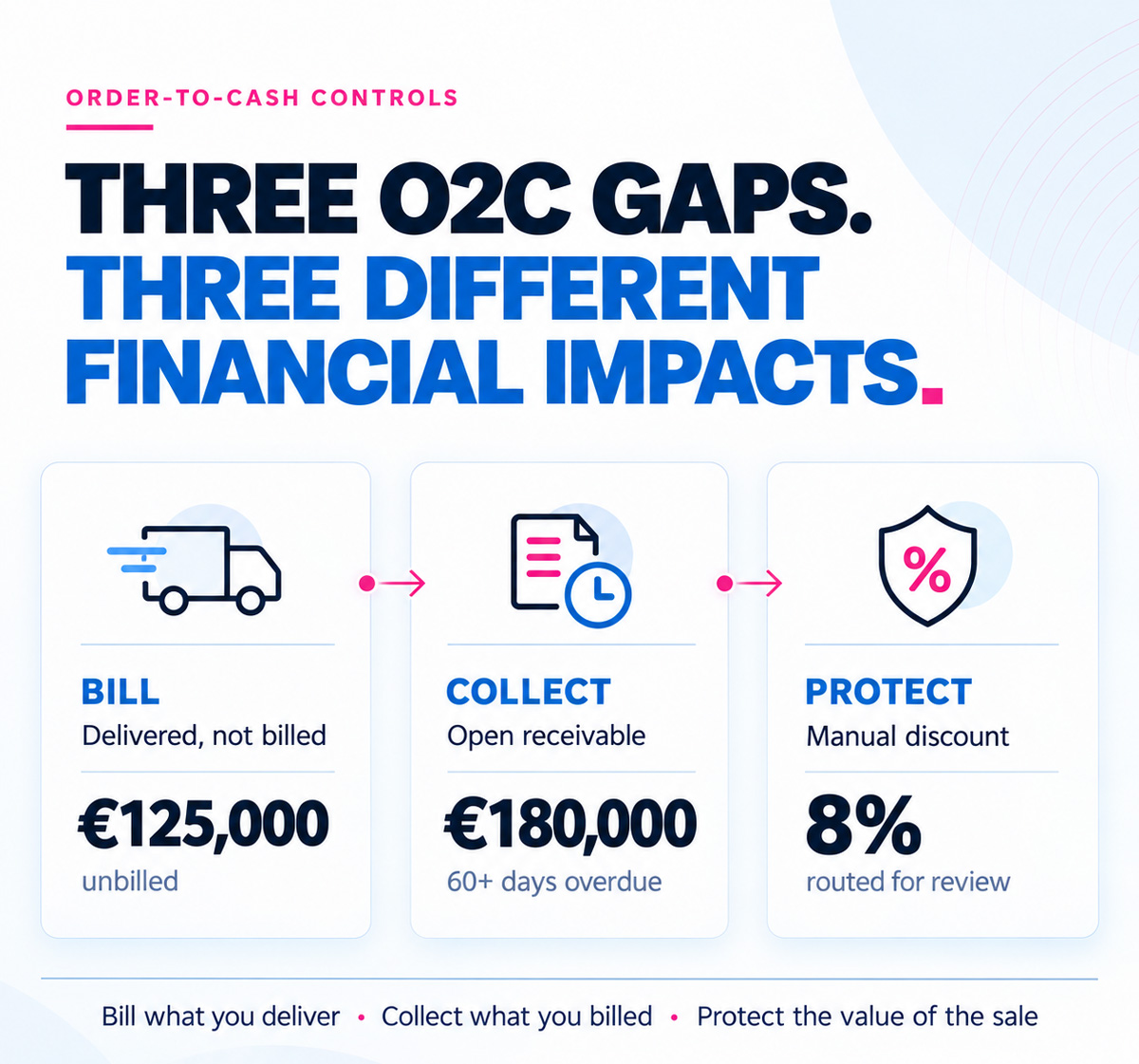
Not every Order-to-Cash issue is the same.
Some affect billing, some delay cash, and others reduce the value of the sale.
A delivery is shipped and the invoice never follows. A receivable becomes overdue and stays on a list without a clear owner. A manual discount reduces the value of a sale without being compared with the approved condition. These are different problems, but the signals already exist in the transaction data. The practical question is whether the relevant case reaches the right person early enough to act.
Most finance organizations already have controls in these areas. Billing is monitored, receivables are reviewed, credit limits exist and pricing is approved. The gap is often not the control objective itself, but the recurring work needed to identify and follow up on exceptions.
For many recurring controls, a report already contains the information needed for the review. But someone still has to download it, apply the relevant filters, identify the cases that require attention and find the responsible person. Repeating this process every week or month takes time and creates room for inconsistency or missed exceptions.
The three areas below cover billing completeness, cash realization and credit exposure, and the commercial value of the sale. They show where automation can strengthen an existing Order-to-Cash control process without changing its underlying objective.
Billing completeness is a natural starting point because the question is straightforward and the amount is measurable. If a delivery is complete but billing is missing, incomplete or late, the value does not enter the collection process as intended.
Consider a delivery worth EUR 125,000. Goods issue was posted 45 days ago, billing was expected within five days, but no complete invoice exists. Operationally, the delivery is finished. Financially, the billing process is still open.
These cases rarely result from one major failure. A valid billing block may never be removed after the underlying issue has been resolved. A partial delivery may result in only a partial invoice. Responsibility for the customer may change. The risk is simply that the exception remains open after the original reason has disappeared.
What automated monitoring can add:
The point is not to wait 45 days. The threshold should reflect the expected billing process, so the case can be raised as soon as it is genuinely late.
Overdue receivables are visible in every aging report. The issue is not whether Finance can see them; it is whether material cases are prioritized, owned and followed through.
Consider an open receivable of EUR 180,000 that is more than 60 days overdue. In an aging report, it is one line among many. As a control case, it becomes a prioritized exception with a clear financial exposure, an owner and a documented outcome that remains visible until the case has been processed.
Receivables monitoring works best when it does not stop at the aging bucket. Two earlier questions often sit behind an overdue balance:
Handled together, these controls connect the overdue balance to earlier process signals. The aging report shows the outcome; credit-limit and payment-term controls help explain how the exposure developed.
The third gap is commercial. Value can be reduced between the approved price and the posted invoice through manual conditions, higher discounts, cash discounts outside the agreed terms or credit memos.
Consider a sales order worth EUR 250,000 where a manual discount of 8 percent is applied. Instead of relying on an approval documented somewhere in an email, the case can be raised for review directly in remQ. The reviewer can approve or reject the discount, document the reason and keep the decision with the case. Where an approval already exists in SAP, remQ can also compare the applied discount directly with the approved value and raise an alert if they differ.
Manual pricing is often legitimate, so a control should not question every manual entry. It should select cases where the value, deviation, customer, user or frequency makes a review useful and give the reviewer the relevant comparison.
Useful monitoring can look at manual conditions and price reductions in sales and billing documents, as well as credit memos compared with what the customer actually paid.
Learn how remQ provides comprehensive business transaction monitoring, internal controls automation, and compliance management. Your data stays where it belongs – securely within your SAP environment.

The common pattern is simple: the data already exists, the logic is repeatable, and someone still has to identify the exception, understand the context and document the outcome.
This is where automation can make a practical difference. The recurring analysis can run on a defined schedule, relevant exceptions can reach the reviewer with business context, and the judgement still stays with the person who understands the case.
remQ adds this control layer directly to SAP-enabled business processes, combining automated analysis with structured review and retained evidence. In remQ, the resulting review cases are presented as alerts.
The three Order-to-Cash control gaps at a glance
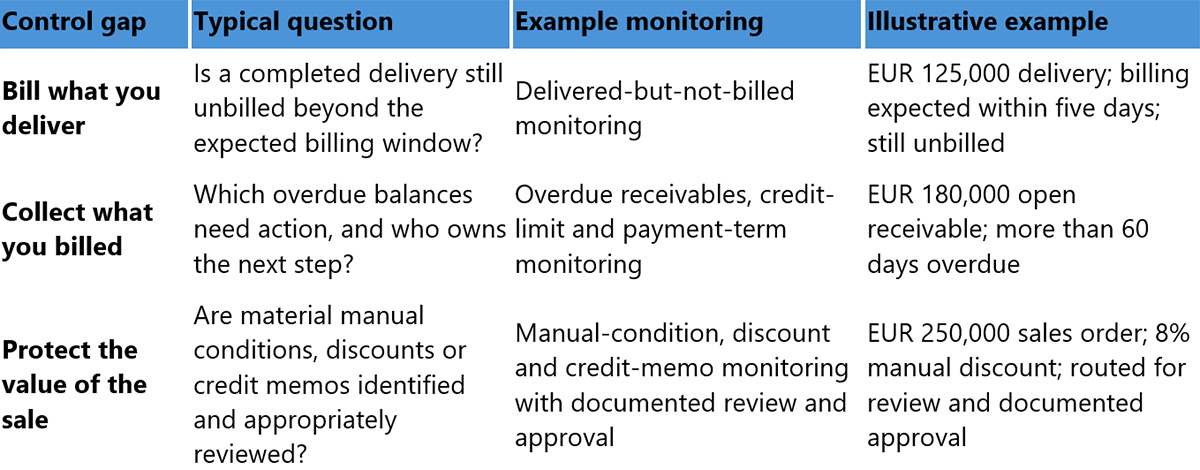
A useful control case contains the amount or financial exposure, customer and organizational responsibility, relevant documents, timing, the parameters that raised the case and a place to record the decision.
The same operating model also answers later control and audit questions: Which population and period were analyzed? Which parameters applied? Which exceptions were raised? Who reviewed them, and what was decided?
You do not need to automate all three areas at once. A strong first wave combines material business relevance, recurring manual effort, reliable data, repeatable logic and a clear owner for review and follow-up.
A practical selection test is:
If several answers are yes, the control is a strong candidate for automation. Billing completeness is often a practical starting point because the case is concrete, the amount is visible and the result can be assessed in the first run.
remQ: Controls | Compliance | Monitoring provides comprehensive business transaction monitoring, internal controls automation, and compliance management.
.png)
Revenue leakage in Order-to-Cash refers to commercial value that is not fully captured in billing as intended, for example because delivered goods are not billed or a price reduction exceeds the approved condition. Overdue receivables are different: the revenue has typically already been recognized, while cash collection is delayed and the credit exposure remains outstanding.
A report shows a population. A control selects the exceptions against defined criteria, routes them to a named reviewer with business context, and keeps the decision, the timing and the evidence with the case.
Billing completeness is often a practical starting point. The case is concrete, the amount is visible, and the first run shows how much delivered value still sits outside the billing process.
No. SAP standard functionality already provides billing due lists, document flow, credit management and aging information. Automated monitoring complements these capabilities by evaluating defined exceptions on a schedule and turning them into documented review cases.
No. remQ runs the controls on the business data in the SAP system, and the alert, the review and the evidence stay in the same process.
An overdue receivable is not automatically revenue leakage. Once revenue has been recognized, it is primarily a cash realization, working capital and credit-risk issue. It can lead to a later write-off, but overdue status alone does not mean that revenue has leaked.


